How to read a wiring diagram
What the lines, dots and colors mean, and which way you're looking at the parts.
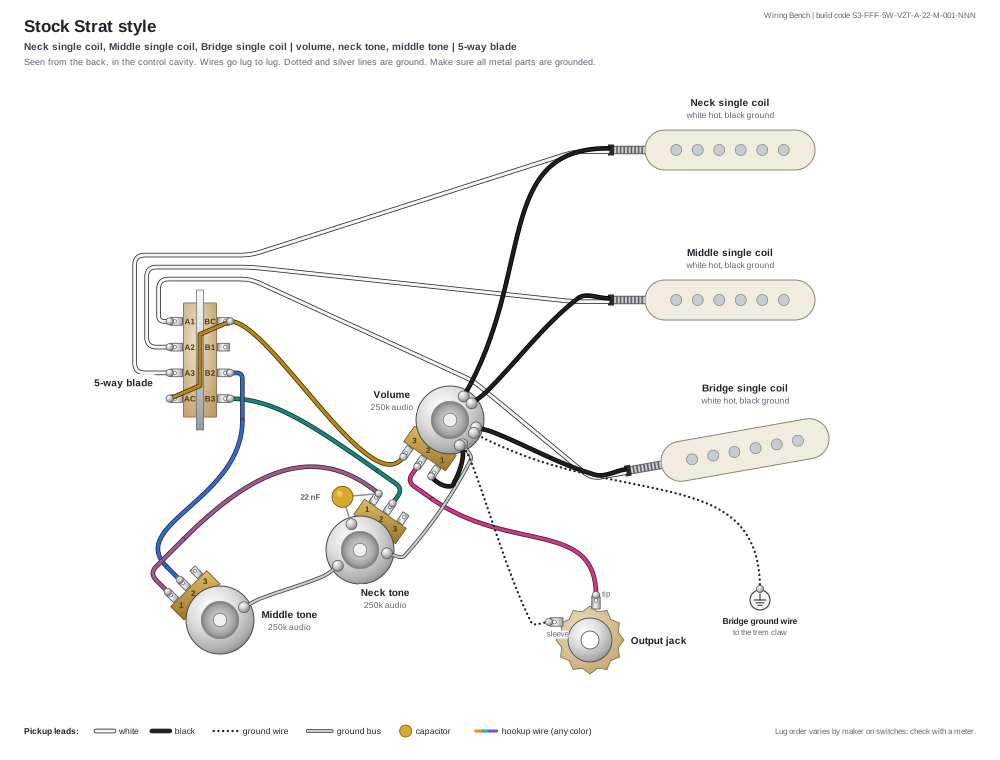
Every drawing on this site shows the parts from the back, the way you see them with the pickguard flipped over or the control cavity cover off. That matters most for pots: the lug numbers you read on the drawing are the lug numbers you'll see in your hand.
Wires and joints
- A colored line is an insulated wire, or a pickup lead in the color it comes in.
- A plain grey line is bare wire, almost always ground.
- A silver dot on a lug is a solder joint. If two lines end on the same dot, they share that joint.
- A dot on a pot's round back is a ground joint soldered to the case itself.
Pots
Looking at the back of a pot with its lugs pointing up, lug 1 is on the left, lug 2 is the middle (the wiper) and lug 3 is on the right. On a volume pot the pickup goes to lug 3, the jack takes its signal from lug 2, and lug 1 goes to ground.
Signal and ground
It helps to trace two paths separately. The signal path starts at each pickup's hot lead and ends at the jack's tip. The ground path is everything else: pickup grounds, pot backs, the bridge wire, and the jack's sleeve. Most faults are a wire sitting on the wrong one of those two paths.
Before you solder, trace one pickup from its hot lead all the way to the jack tip with your finger. Then do the same for its ground lead to the jack sleeve.